


Why Flash Changes Everything in Street Photography

Updated: Aug 6
Flash isn’t just a tool for portraits or events, it can completely reinvent the way you see and capture the streets. This article will probably be most useful for a fairly specific audience - those who are beginning to experiment with flash on the streets. The experienced flash photographer knows everything here and a lot more. Someone who never uses flash - like I was a few months ago - might find it overwhelming or baffling.
Until last September, my street photography style was all about chasing natural light and teaching myself how to make the most of what it gave me. I still do that most of the time. But the combination of shorter days and being inspired by a workshop led by Bert De Busschere at the Rome Photo Lab festival led me to try flash photography in the streets. Bert’s work demonstrates the potential of flash to create surreal magic, and many other photographers use it to produce their own style of amazing results. I’m not there yet, but I’ve learned a lot and some of it might be helpful to others.
A quick note on my equipment, although I think a lot of things hold true across a wide range of tools. I use a Canon EOS R8 and a Canon Speedlite EL-100 that I bought for indoor portraits and events. This flash probably wouldn’t be anyone’s first choice for street (the only trigger that allows you to use it off camera is another Speedlite), but I didn’t want to buy more gear until I was sure that flash was for me.
Is it? Yes! At least, I’m impressed by the versatility and results it’s possible to achieve. Flash not only expands your shooting time on short winter days but makes backlit and shadowed faces visible.
On sunny afternoons, I seek out contrast between bright, celebratory colors and evening shadows. With a little imagination, the long shadows seem to represent fall chill encroaching on long summer days.
Possibly because of the charged, holiday atmosphere, people show their emotions more readily. You can capture facial expressions and gestures that convey excitement, concentration, discomfort or disagreement.


Flash can also make colors and faces “pop” on overcast days or when you’re shooting on the shady side of the street. Each of these images owes its clarity and vibrant colors to flash, although none of them were taken at night (4-6). Check the images below.


I don’t have the knowledge or space to provide a comprehensive guide to street flash, so I’ll stick to calling out some areas that have been (and continue to be) interesting challenges for me. The main issue, I think, is that my natural light shooting habits have become automatic, and I need to train myself to think differently to use flash effectively.
If you’re ready to take up flash and looking for comprehensive instruction, I highly recommend Robin Shimko’s Ultimate Guide to Flash in Street Photography .
Don’t forget to download Robin’s catalogue of shots and settings – I found it especially helpful and inspiring. There are also many resources available about related topics like zone focus, including apps like Depth of Field that provide details on your zone when you enter your lens size and aperture setting. The best article I’ve come across on zone focus is from Alex Coghe. I discovered it recently, and I look forward to trying out his suggestions, including focus peaking, which is a totally new concept for me.
And now for those challenges….Get Back!
Whoever said “get closer” when asked how to take better street photos may not have been thinking about flash photography. The flash brightens the first thing it hits, whether it’s the subject you have in mind or not. It also overexposes anything nearby and tends to blow out anything white. If you’re looking for that effect, that’s great. If not, it’s a good idea to take a few steps back and try again. When I’m shooting in natural light, there’s no penalty and some benefit to getting closer, so this is an area where I need to modify my habits when I’m using flash.
This skeleton, which is close and white, really stands out. The “bones” reflect a lot of flash and steal attention from the more expressive human beings. (inset image below)
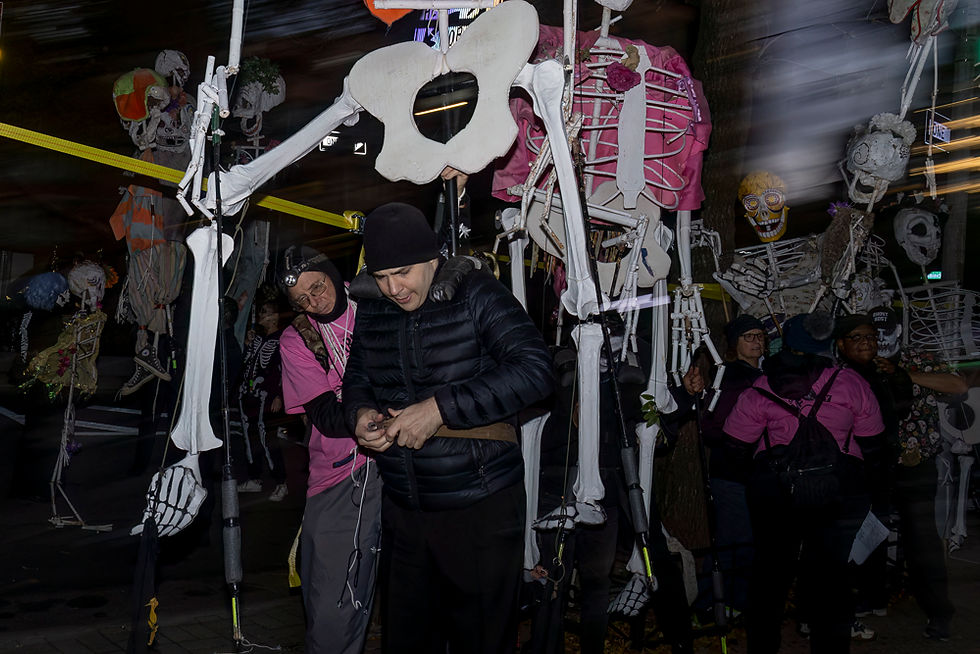
Because auto-focus tends to fail in low light, my transition to evening and nighttime work with flash involved not only the flash itself, but also a new way of using my camera. I have developed the habit of using back-button focus when I shoot during the day. This enables me to focus on my subject using my auto-focus system while allowing me to compose my scene by moving the camera. Many street photographers would say zone focus is faster and more accurate - and given practice, they’d be right. But switching to zone focus was (and still is) a transition for me.
If you’re not familiar with zone focus, in brief, it’s using a narrow aperture and wide lens (28mm or 35mm) to increase depth of field and create a large zone where everything is in focus. Your zone is largest in cases where your focal point is more distant – more expansive at six feet than four feet, for example, and tiny at anything less than that. As far as I can see, you need a great deal of skill and practice to work within a small zone. I don’t have that yet, so I’m practicing by setting my focal point at six feet and setting my 28mm lens at f.8-f.11. This means that if I follow my daytime urge to get closer than four feet to my subject, they’re going to be out of focus. The people behind them, by contrast, will be perfectly sharp. It’s an odd look, and I can’t think of a way to salvage it.
Here’s an example where it came out more or less right, but you can see the factors at work. My subject, the two women interacting at the center, are well over six feet away from me and in focus, as is the man behind them. The person at the far left (who fortunately is not my subject) is too close to the camera and out of focus. I’ll explain the light effects later.

Settings
What’s the slowest shutter speed you typically use? Many street photographers say 1/400 or faster. I go down to 1/250, but for the most part, I don’t even think about anything slower than that. During the day, a slow shutter results in motion blur. Because it freezes subjects by making them visible for an instant, flash allows you to get clear images at 1/30, 1/15 and even slower. Your choice of shutter speed when using flash isn’t about motion blur. Instead, it’s a variable in deciding how much outside light (that’s light in the environment other than the flash) enters your image to illuminate the scene. My daytime shutter choices wouldn’t make my flash images sharper - they would just eliminate the light that enables you to see anything other than what is hit by the flash.

The flash freeze effect only works when the ambient light is very low – not just late afternoon, but well into dusk. If you want to shoot this way, you need to do the opposite of what I do in the daytime – seek out the dark instead of the light.


In my daytime photography, I tend to shoot Manual, setting aperture and shutter and letting my ISO float. I’m persnickety about noise and treat ISO as a “noise indicator” that I want to keep as low as possible. This way of thinking about ISO doesn’t make sense with flash. Instead, ISO is another way of controlling how much ambient light (available in the scene apart from the flash) gets into the image. A lower setting (say 100) will result in a darker background, making the scene behind the flash less visible than a higher setting (like 1600 or more).
Now a comparison set again for you to dig deeper, check the inset images below, these images illustrate this point. They are cropped but unedited.


Effects
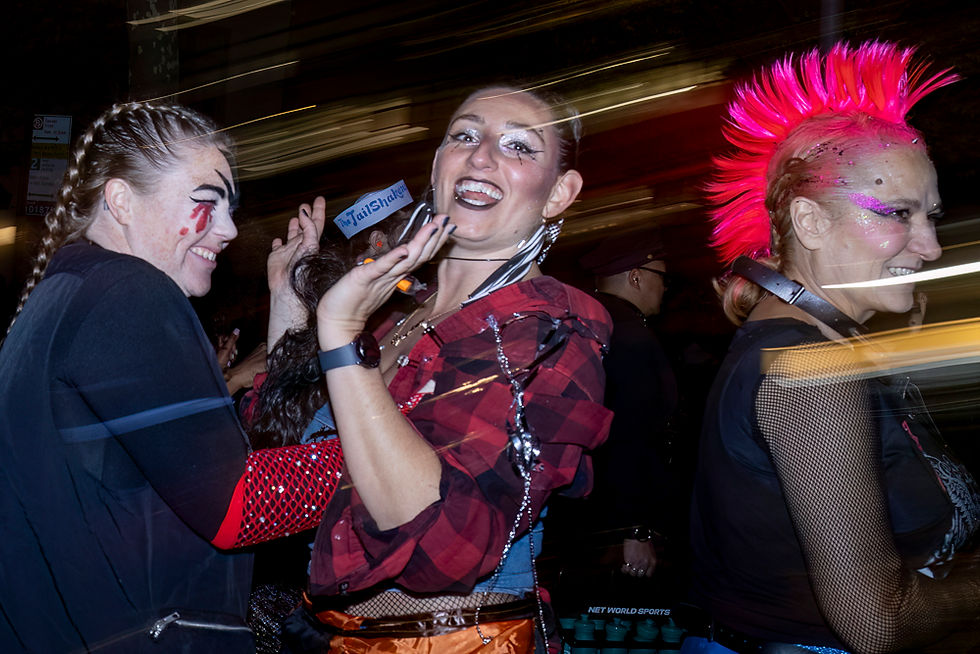
Flash gives you the option of creating light trails and effects that you just can’t get using natural or available light. This suggests energy and motion, and you can tell that I got really excited by this effect, because I’ve used it in many of the photos shown here. The technique is easy – moving the camera slightly when you’re shooting with flash at a slow shutter speed. You can see it in photos 3-5 and also below. Of course, it only works when there are lights in the area – in pitch black, nothing happens.

I hope I’ve conveyed the opportunities and excitement of shooting with flash on the street, while also helping natural‑light photographers sidestep some of the early mistakes I encountered. There are still many aspects I’ve yet to explore-like managing battery drain with ETTL or experimenting with off‑camera setups, but that’s part of the journey. I may be a flash and night photography novice, yet each outing brings new lessons, sharper instincts, and creative breakthroughs. Festivals and events have been my training ground, but I’m determined to carry this tool into everyday street settings as well. Flash has expanded my vision, given me shots I could never achieve with natural light alone, and opened a path I’m excited to keep walking. If this piece helps even a few photographers take that first step, then it has already done its job.
-Kimberly Keller Why Flash Changes Everything in Street Photography
Do you have unshared night flash photography that has the potential to win a Global Award? You must submit your work here before the deadline closes https://www.streetphotography.gallery/
If you are a street photographer and own a credible body of work, you can be featured in The Street Photography Gallery’s Feature section. You only have to hit the button below or email us on thestreetphotographygallery@gmail.com


Hi Kim,
I’m really glad I found your post, and really like the look of the images! I wonder if you use an ND filter in the day at all, and if so how strong? I aim to get the night time movement blur but in the daytime. Any advice much appreciated!
Cheers, Gary.
Difficult made simple through your personal experiences, thank you <3
Well written and well sampled. Helpful🤘